The whole platform is an API, with a Python SDK to match
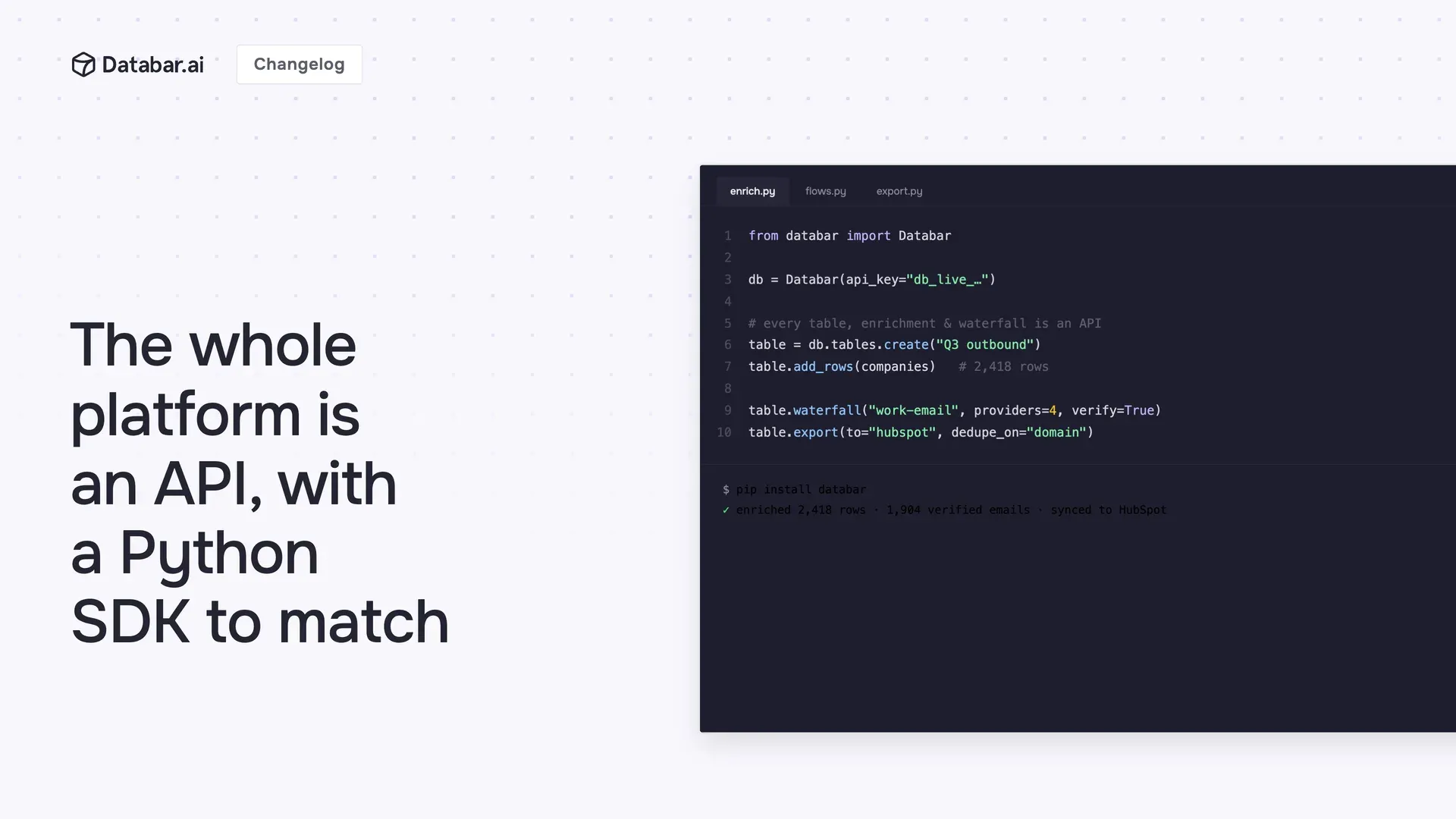
For a long time, the Databar API did exactly one thing: run enrichments. That's over. Everything you can do in the app, you can now do over HTTP.
What the API covers now
Build lists, attach sources with a command. Build lists of companies, people, job postings, and CRM records programmatically.
Run enrichments, waterfalls, and flows and get structured results back, one row at a time or in bulk. All enrichments in your Databar workspace are available via API to deploy instantly.
Turn a flow into an endpoint. Every flow you build on the canvas (Monday’s launch) is callable with a single API request: send inputs, get the pipeline's structured output back. Design the logic once, visually, then run it from your product, your scripts, or your backend forever.
Move & de-duplicate rows in batches. Insert, update, upsert, or delete rows in a single call, with server-side deduplication and columns created automatically when your data has new fields.
Build tables programmatically. Attach enrichments, waterfalls, and exporters to a table, with columns mapped automatically.
Bring your own sources and destinations. Register custom HTTP connectors, run exporters to push results into your CRM, and organize everything with folders.
Run on your own provider keys. The API remembers your default key per data provider, so requests can run on the subscriptions you already pay for instead of spending credits.
Discover what's available. Search and filter the enrichments by category or keyword, and fetch valid parameter choices, so you can build pickers and automations on top of Databar itself.
🏭 It behaves like an API you'd want in production
Every task reports exactly how many credits it spent. Reads support filtering and pagination. Rate limits come back as clean 429s instead of mystery failures. And a run_errors mode lets you re-run only the rows that failed, so retries don't cost you a full second pass.
🎇 The Python SDK: GTM Pipelines in Python
If you'd rather not hand-write HTTP, the Python SDK wraps all of it:
pip install databarThe rewritten SDK turns Databar into a building block you can compose. Chain enrichments, waterfalls, flows, and your own logic into a repeatable GTM pipeline, then drop it wherever you already run Python: a cron job, an Airflow, a backend service, or a notebook. And when you've already designed a pipeline visually as a flow, you don't rebuild it in code: list it, run it, and get its output back in a couple of lines.
from databar import DatabarClient
db = DatabarClient(api_key="...")
for lead in leads:
     email   = db.run_enrichment_sync(EMAIL_FINDER, {"name": lead.name, "domain": lead.domain})

company = db.run_enrichment_sync(COMPANY_ENRICH, {"domain": lead.domain})

# then your logic: score it, filter it, push it to your CRM
Go sync when you want the answer right now, or async with task polling when the job runs long. Large row operations are auto-batched, so you can push thousands of records without babysitting them. And it's built for production: typed (Pydantic) models, automatic retries with backoff, and a typed exception for every failure mode, so you can catch "out of credits" or a rate limit and handle it gracefully instead of watching your job crash.
Explore the API reference · Read the SDK docs
Heads-up for existing API and SDK users (breaking change): bulk-run results now come back as a positional list that lines up with your inputs, one result per input, in order, with
nullfor misses, instead of an unordered list of hits. Match results to inputs by position.
About Databar
Databar replaces your go-to-market data stack with one platform. Search companies, people, and jobs, monitor the web for signals, and enrich it all with 160+ data sources and waterfalls. Wire everything into reusable automations that run on a schedule, on your tables and CRM data, or by an AI agent. App, API, MCP server, SDK, and CLI included on every plan.